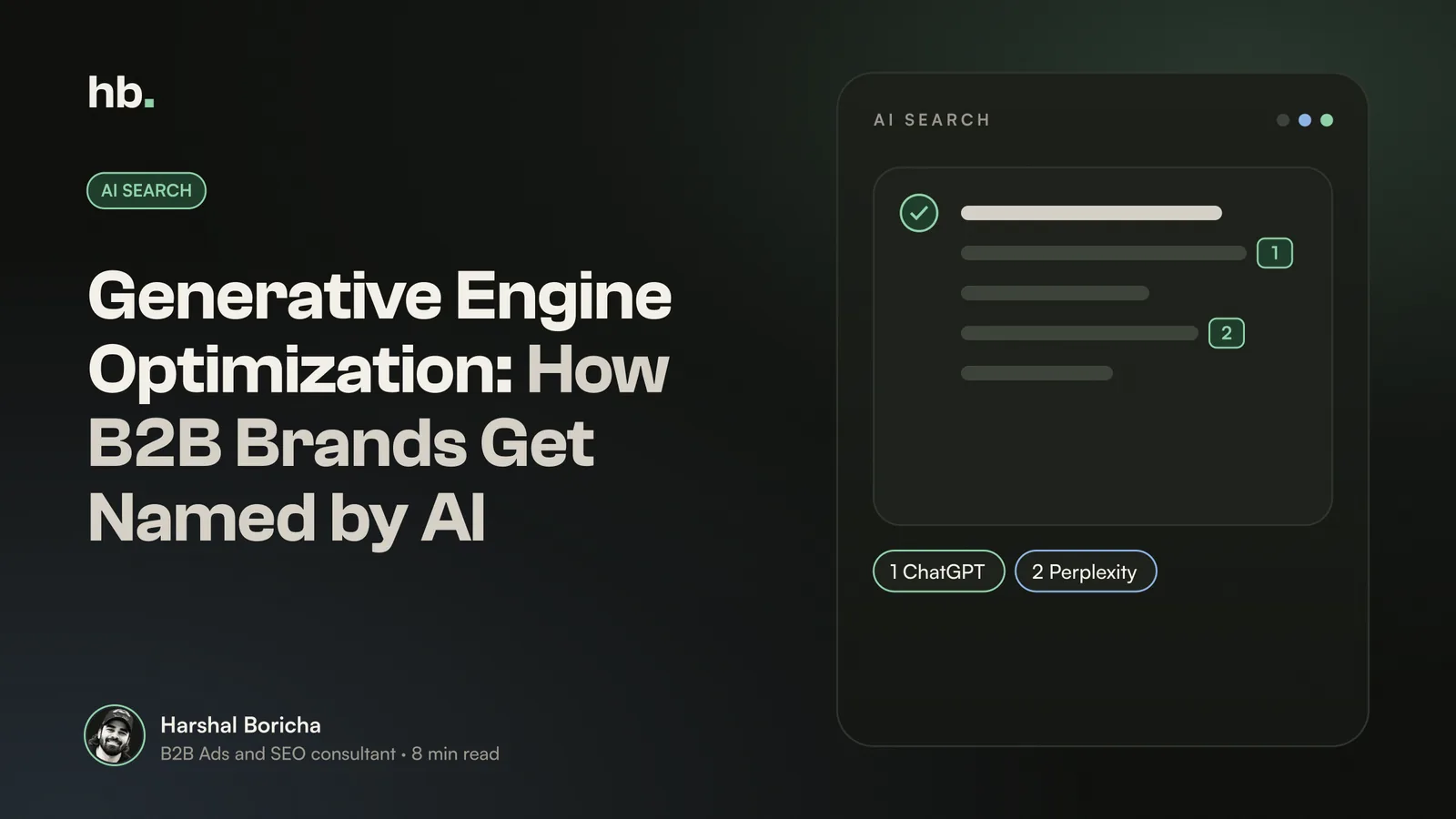
Your buyers are asking ChatGPT, Perplexity and Google's AI Overviews to shortlist vendors before they ever visit your website. If your company is not named in those answers, you are not on the list, however well your blog ranks. This guide explains generative engine optimization in plain terms, how AI tools choose their sources, and the checklist I use with B2B companies to get them cited.
What is generative engine optimization?
Generative engine optimization (GEO) is the work of making your brand and content more likely to appear inside answers written by AI systems. That includes ChatGPT search, Perplexity, Gemini, Copilot and Google's AI Overviews and AI Mode. You will also hear it called answer engine optimization (AEO) or simply AI search optimisation. The labels differ, the job is the same.
The term comes from a research paper, GEO: Generative Engine Optimization by Pranjal Aggarwal and colleagues, first posted on arXiv in November 2023 and later accepted at KDD 2024. The authors built a benchmark of queries across many domains, called GEO-bench, and tested which content changes made a source more visible in AI-generated answers. Their headline finding was that the right changes can lift visibility by up to 40%.
Three results from that paper shape how I work:
- Adding quotations, statistics and cited sources helped most. These were the strongest single methods in their tests, and fluent, readable writing helped too.
- Keyword stuffing did not work. It actually scored below the unoptimised baseline. Old SEO habits do not carry over.
- Smaller sites gained the most. Sources that ranked lower in normal search saw the biggest lift from adding citations, quotes and data, while top-ranked sources sometimes lost visibility.
That last point matters for B2B. A mid-sized Indian SaaS or industrial company with modest domain authority can still be the source an AI tool quotes, if its content is the clearest and most specific on the topic.
How GEO differs from SEO
GEO is not a replacement for SEO. AI search tools still crawl and index the web, and Google is explicit that pages must be indexed and eligible for a snippet to appear in its AI features. If your B2B SEO strategy is weak, GEO has nothing to stand on.
What changes is the unit of success. In SEO you win a click. In GEO you win a mention, a citation or a line in a shortlist, often with no click at all.
| Traditional SEO | Generative engine optimization | |
|---|---|---|
| Goal | Rank a page, earn a click | Get named or cited inside the answer |
| Main unit | Keyword and URL | Entity (your brand) and facts about it |
| What helps most | Relevance, links, technical health | Clear facts, original data, third-party mentions |
| Typical query | "B2B payroll software India" | "Which payroll tools suit a 200-person Indian manufacturer, and why?" |
| How you measure | Rankings, clicks, conversions | Prompt tracking, citations, AI referrals, self-reported source |
The queries are longer and more conversational. A procurement head might paste in their exact situation and ask for three options with pros and cons. Your job is to make it easy for the model to understand who you are, who you serve and why you belong in that answer.
How LLMs pick which sources to use
Nobody outside OpenAI, Google or Perplexity knows the full selection logic, and anyone who claims otherwise is guessing. But the public documentation and research give us a working model.
They retrieve before they write
For anything current or specific, AI search tools run a web search, pull a handful of pages and then write an answer from them. Each tool has its own crawler for this. OpenAI's crawler documentation says sites that block OAI-SearchBot will not appear in ChatGPT search answers. Perplexity's documentation says PerplexityBot is what surfaces and links sites in its results. If you block these bots, you are invisible no matter how good the content is.
They favour pages that answer cleanly
When a model has five retrieved pages and needs one sentence about pricing models, it leans on the page that states the answer directly. Pages with specific numbers, named definitions and clear structure are easier to lift from. That matches the GEO paper's finding that statistics and citations raise visibility.
They lean on what others say about you
An AI tool is more confident naming a brand that many independent sources mention. Ahrefs studied 75,000 brands and found branded web mentions had the strongest correlation with appearing in AI Overviews, around 0.66, well ahead of backlinks at around 0.22. Ahrefs itself notes that correlation is not causation, but the direction is clear: off-site reputation counts for more than it did in classic SEO.
A practical GEO checklist for B2B companies
This is the checklist I work through. It is ordered roughly by effort, cheapest first.
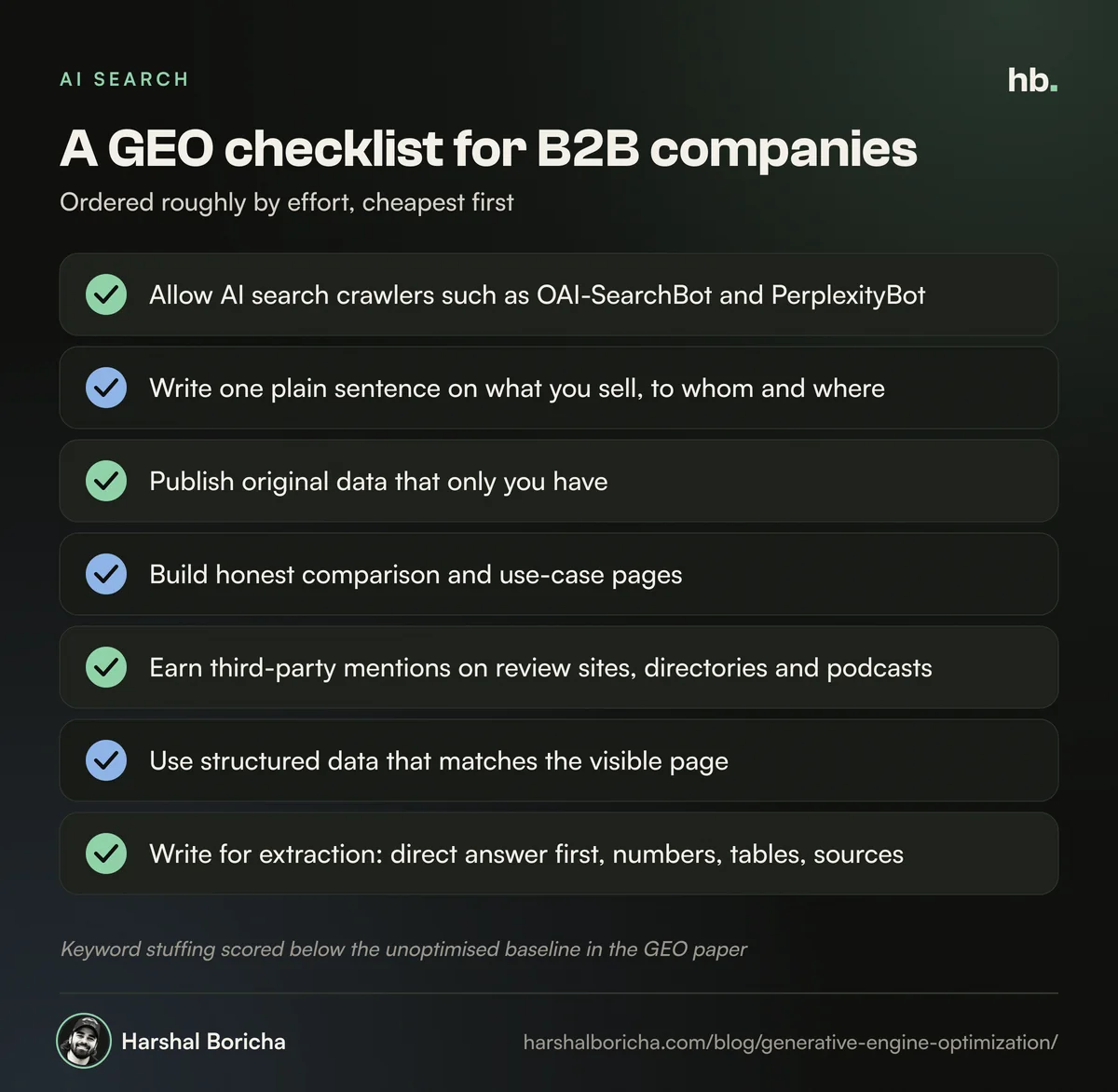
1. Make your crawlability AI-friendly
Check your robots.txt and your CDN or firewall settings. Security tools often block unfamiliar bots by default, and on many B2B sites nobody notices. Google's own guidance reminds site owners to check the CDN and hosting layer, not just robots.txt.
- Allow Googlebot (AI Overviews and AI Mode use normal Google Search crawling).
- Allow OAI-SearchBot for ChatGPT search and PerplexityBot for Perplexity.
- Decide separately on training crawlers like GPTBot and Google-Extended. Blocking training is a business choice; blocking search crawlers costs you visibility.
- Keep key content in HTML text, not locked inside images, PDFs or heavy scripts.
2. Fix entity clarity
The model needs to know, without doubt, what your company is. Write one plain sentence that says what you sell, to whom, and where, and use it consistently on your homepage, About page, LinkedIn page and directory listings.
Say you sell warehouse automation software to third-party logistics firms in India and the GCC. That exact phrasing should appear in many places, not "next-gen intelligent supply chain enablement". Vague positioning gets you left out of specific answers. Our B2B marketing glossary is a good place to sanity-check the terms you use.
3. Publish original data
This is the single biggest lever I see for B2B. A model cannot cite you for something everyone else also says. It can cite you for a number only you have.
Run a short survey of your customers, publish anonymised benchmarks from your product, or share pricing ranges for your category. Even a modest "we analysed 120 RFPs we received this year" piece gives AI tools a reason to name you.
4. Build comparison and use-case pages
Buyers ask AI tools comparison questions all the time: "X vs Y", "best tools for Z", "alternatives to W". If you do not have honest comparison pages, the model will use someone else's.
- "Your product vs competitor" pages that are fair, including where the competitor is a better fit.
- "Best for" pages by industry, company size or use case.
- Pricing explainers, even if you only share ranges.
Good B2B keyword research will surface the comparison terms your buyers actually use.
5. Earn third-party mentions
Given the Ahrefs findings, I now treat brand mentions as seriously as links. Get listed on the review sites and directories your category uses, contribute data to industry publications, speak on podcasts, and get customers to talk about you on LinkedIn. Unlinked mentions still count for building the picture an AI tool forms of your brand.
6. Use structured data honestly
Add Organization, Product, FAQ and Article markup where it fits. Google recommends JSON-LD in its structured data guide, and its AI features guidance stresses that markup must match the visible text on the page.
One caution. Google's guidance on AI features says "there are no additional requirements to appear in AI Overviews or AI Mode". It also says you do not need special AI text files or new schema. So do not let anyone sell you an llms.txt file as the answer. Spend that effort on content and mentions.
7. Write for extraction
Format pages so a model can lift a clean answer:
- Put the direct answer in the first two sentences under each heading.
- Use specific numbers, named sources and short definitions.
- Add tables for comparisons and specs.
- Cite your own sources, as the GEO paper found this raised visibility.
How to measure GEO
Measurement is the weakest part of GEO today, so be realistic. Google counts AI Overviews and AI Mode traffic inside the normal Search Console Performance report, under the Web search type, rather than in a report of its own. Other tools give you even less. I use three layers.
Prompt tracking
Pick 20 to 30 prompts your buyers would actually type, such as "best ERP partners for mid-size pharma companies in India". Run them monthly in ChatGPT, Perplexity, Gemini and Google, and record whether you are named, cited with a link, or absent. Keep the list fixed so the trend means something.
AI referral traffic
In GA4, watch referral sessions from AI assistants' domains and compare their engagement and lead rate with other channels. The volume is usually small, but these visitors often arrive with intent. If you have not yet connected leads to revenue, my guide on tracking B2B leads to revenue shows how.
Self-reported attribution
Add a free-text "How did you hear about us?" field to your demo or contact form. In B2B, many buyers who first met you inside an AI answer come back later through branded search or a direct visit, and analytics will never connect the two. Your sales team's notes will.
How I approach GEO for clients
I start with an audit: bot access, entity consistency, the prompts that matter in your category and who currently gets named. Then I prioritise the two or three gaps that are cheapest to close, usually original data and comparison pages, and build a monthly tracking sheet so you can see movement.
GEO sits on top of solid organic search work, so I run it alongside B2B SEO rather than as a separate stunt. The brands that show up in AI answers are almost always the ones that already have clear, authoritative pages and mentions across the web. If you want to know where your brand stands in AI answers today, have a look at my AI search optimisation service or book a call.
The short version
- Generative engine optimization means getting your brand named or cited inside AI answers, not just ranked in blue links.
- It builds on SEO: if AI crawlers cannot reach you, nothing else matters.
- Original data, citations, clear entity statements and honest comparison pages do the heavy lifting; keyword stuffing does not.
- Third-party mentions now carry real weight in whether AI tools trust and name your brand.
- Measure with a fixed prompt list, AI referral traffic and a "how did you hear about us" field.
Frequently asked questions
What is generative engine optimization?
Generative engine optimization (GEO) is the practice of making your content and brand more likely to be used, cited or named in answers written by AI systems such as ChatGPT, Perplexity, Gemini and Google AI Overviews. The term comes from a 2023 research paper by Aggarwal and colleagues, which tested how content changes affect visibility inside AI-generated answers.
Is GEO different from SEO?
GEO builds on SEO rather than replacing it. AI search tools still rely on crawling and indexing, so technical SEO and helpful content remain the base. The difference is the goal: SEO aims for a ranked click, while GEO aims for your brand to be mentioned or cited inside the answer itself, which depends more on clear facts, original data and what other sites say about you.
How do I get my company cited by ChatGPT?
Make sure OpenAI's search crawler, OAI-SearchBot, is allowed in your robots.txt, publish pages that state clearly what you do and for whom, add original data and specific facts, build comparison and use-case pages, and earn mentions on third-party sites your buyers trust. There is no guaranteed method, so track a fixed set of prompts monthly.
Do I need special markup or an llms.txt file for AI Overviews?
Google says there are no additional requirements or special optimisations needed to appear in AI Overviews or AI Mode. A page needs to be indexed and eligible to show a snippet. Google also says you do not need new machine-readable files or special schema for this. Structured data is still useful if it matches the visible text on the page.
How do you measure generative engine optimization?
Use three layers. Track a fixed list of buyer prompts across ChatGPT, Perplexity, Gemini and Google each month and note whether you are named or cited. Watch referral sessions from AI assistants in GA4. Then ask every new lead how they found you, because many AI-influenced buyers arrive later through branded search or direct visits.
Sources
- GEO: Generative Engine Optimization, Aggarwal et al. (arXiv, KDD 2024)
- AI features and your website (Google Search Central)
- Intro to how structured data markup works (Google Search Central)
- Overview of OpenAI crawlers (OpenAI)
- Perplexity crawlers (Perplexity)
- An analysis of AI Overview brand visibility factors, 75K brands studied (Ahrefs)

B2B Ads and SEO consultant in Mumbai. Nine years in performance marketing, working only with B2B teams. More about me.
Want help with AI Search (GEO)?
Generative engine optimization (GEO) for B2B brands. Get cited by ChatGPT, Perplexity, Gemini and Google AI Overviews when buyers research vendors.