If you have ever opened a keyword tool for your B2B product and seen "10 searches a month" next to every term that matters, you are not doing it wrong. That is what B2B search looks like. In this guide I will show you how I approach B2B keyword research: why tiny volumes can still be your most valuable keywords, where to find the terms tools miss, and how to map each one to the right page.
Why B2B keyword volumes are tiny but valuable
Consumer brands chase keywords with tens of thousands of searches. B2B rarely has that luxury. The number of people in India who need, say, warehouse automation for cold storage is small, and only a handful of them are searching in any given month.
But look at the maths from the other side. If one customer is worth ₹20 lakh a year, a keyword that brings you one qualified demo a quarter is a serious asset. A blog post with 10,000 visits from students and job seekers might bring nothing.
Ahrefs looked at this question directly. Their finding was that low-volume keywords are more likely to be buyer-focused, though not always, and that keyword tools can underestimate real searches. In one example, Search Console showed roughly twice the searches the tool estimated. In a small test, the average zero-volume keyword earned about 11 impressions, so do not expect hidden goldmines. Expect small numbers that matter when the deal size is large.
That is the mindset shift. In B2B keyword research, the question is not "how many people search this?" It is "who searches this, and what are they about to do?"
Understand keyword intent before you look at volume
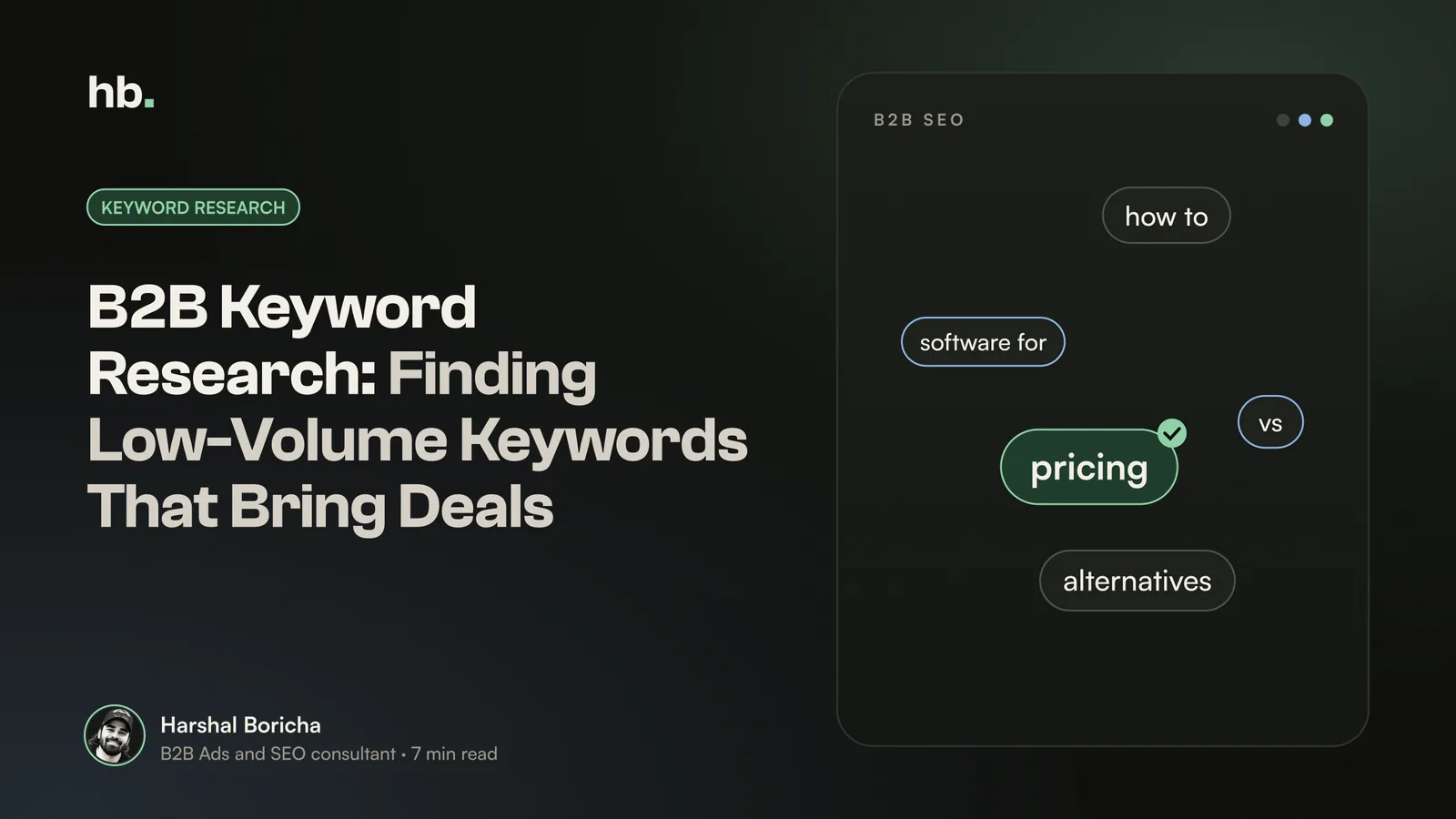
Semrush groups keyword intent into four types: informational, navigational, commercial and transactional. For B2B, I translate them into stages of a buying decision:
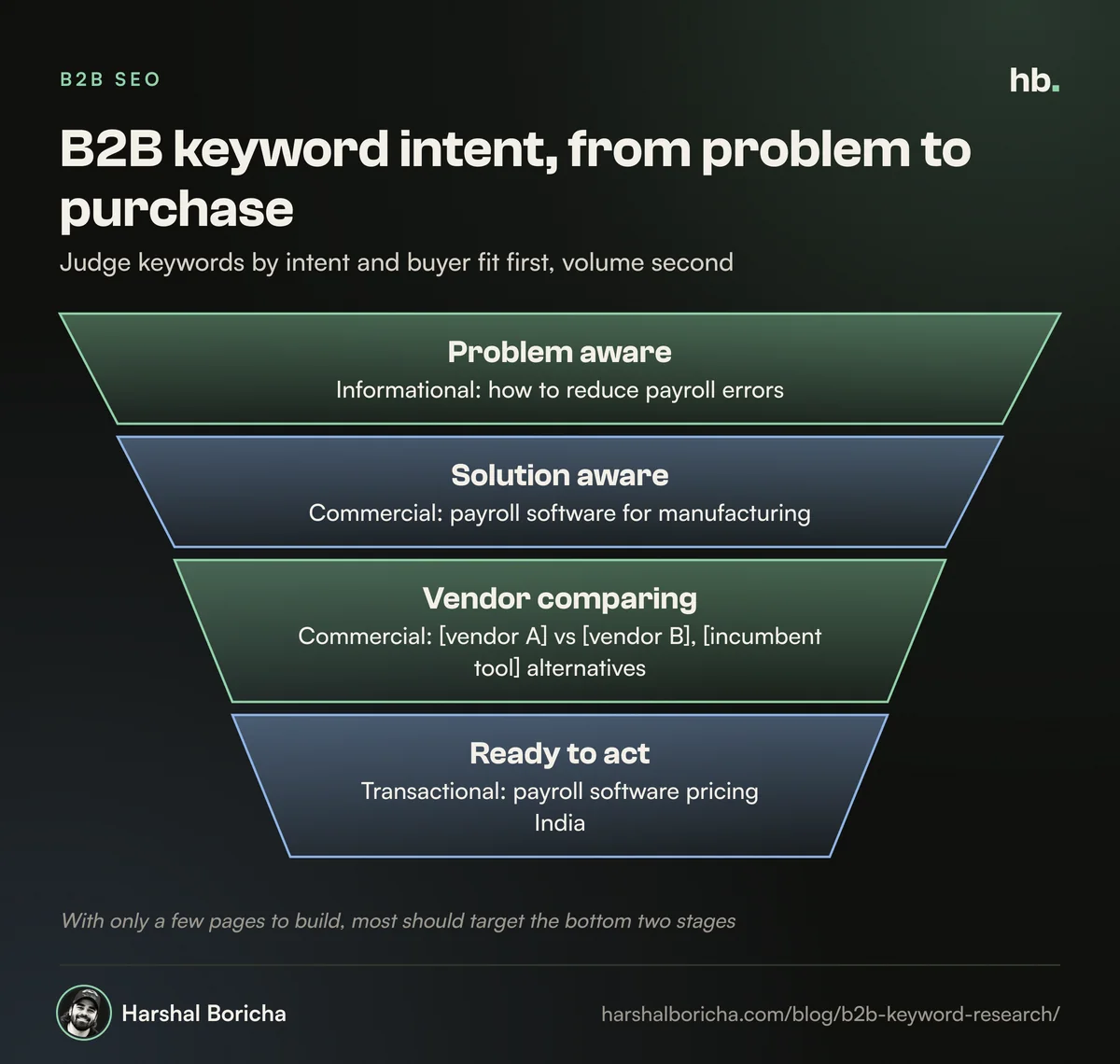
- Problem aware (informational): "how to reduce payroll errors", "what is GST reconciliation".
- Solution aware (commercial): "payroll software for manufacturing", "best GST reconciliation tool".
- Vendor comparing (commercial): "[vendor A] vs [vendor B]", "[incumbent tool] alternatives".
- Ready to act (transactional): "payroll software pricing India", "book payroll software demo".
HubSpot's B2B SEO guidance makes a similar split and suggests prioritising the comparison and conversion layers, because those signal purchase readiness. I agree. If you only have the budget for 10 pages this quarter, most of them should target the bottom two stages.
Where to find B2B SEO keywords that tools miss
Keyword tools are useful for B2B keyword research, but they only show you what is already popular. Your best B2B SEO keywords often come from places no tool can see.
1. Mine your sales calls
This is my favourite source, and the most underused. Your sales team hears buyers describe their problem in their own words every single day.
Here is a simple process:
- Pull 10 to 20 recent call recordings or call notes, ideally a mix of won and lost deals.
- Write down the exact phrases prospects use for their problem, not your marketing team's version.
- Note every competitor, tool or workaround they mention.
- List the objections and questions that came up more than once.
- Group similar phrases and check each group in Google to see what currently ranks.
You will often find that buyers call the problem something completely different from what your website calls it. That gap is a keyword opportunity, and a messaging fix too.
2. Read your CRM
Your CRM holds years of buyer language. Look at lead form messages, "how did you hear about us" answers, lost-deal reasons and the industries and job titles of closed deals.
Closed-won data is especially useful. If 40% of your revenue comes from logistics companies but your site has no logistics page, you have just found a keyword cluster worth building.
3. Study competitors
Look at which pages your competitors have built and which search terms bring them traffic. Tools like Ahrefs and Semrush show this. Pay most attention to their comparison, use case, industry and pricing pages, because those are the pages they built to win deals.
Do not copy their keyword list blindly. Your positioning may be different, and some of their traffic will be people you do not want.
4. Use Google Search Console
Search Console shows the real queries your site already appears for, with clicks, impressions, click-through rate and average position. It is free, and it is first-party data from Google itself.
What I look for:
- Queries with impressions but almost no clicks. Google thinks you are relevant, but your page or title is not convincing.
- Queries sitting in positions 8 to 20. These are close, and a better page often moves them up.
- Queries you never planned for. These reveal how real buyers phrase things.
Two limits to know. Google says the report omits rare queries to protect user privacy, and the tables show a maximum of 1,000 rows, with larger exports available through the API. For low-volume B2B sites, that means some of your most specific queries may never appear. That is one more reason sales calls and CRM data matter.
5. Check your paid search terms
If you run Google Ads, the search terms report shows exactly what people typed before clicking your ad, and which terms led to leads. It is the fastest way to test keyword intent with real money. I cover this in my guide to Google Ads for B2B, and the flip side, cutting the wrong terms, in negative keywords for B2B Google Ads.
How to map keywords to pages
A long keyword list is useless until each term has a home. This is the step that turns B2B keyword research into rankings and leads. Keyword mapping means deciding which page on your site should rank for which group of keywords.
My rules are simple:
- One page, one main intent. A pricing search and a "what is" search need different pages.
- Group by shared results. If two keywords bring up mostly the same results in Google, target them on one page. If the results differ, they need separate pages.
- Map to existing pages first. Improving a page Google already knows is faster than starting a new one.
- Every page gets a next step. Early-stage pages link to solution pages. Solution pages link to demo or contact.
A sample keyword mapping table
Say you sell payroll software to mid-sized manufacturers in India. A first-pass mapping might look like this. The volumes are illustrative, not real data.
| Keyword group | Intent | Stage | Target page | Page type |
|---|---|---|---|---|
| payroll software for manufacturing companies | Commercial | Solution aware | /solutions/manufacturing-payroll/ | Solution page |
| payroll software pricing india, payroll software cost per employee | Transactional | Ready to act | /pricing/ | Pricing page |
| [your brand] vs [competitor] | Commercial | Vendor comparing | /compare/[competitor]/ | Comparison page |
| [competitor] alternatives | Commercial | Vendor comparing | /alternatives/[competitor]/ | Alternatives page |
| contract labour payroll compliance, shift wage calculation | Informational | Problem aware | /blog/contract-labour-payroll/ | Guide |
| how to calculate overtime under factories act | Informational | Problem aware | /blog/overtime-calculation-factories-act/ | Guide |
| payroll software tally integration | Commercial | Solution aware | /integrations/tally/ | Integration page |
Notice the pattern. The bottom half of the funnel gets dedicated, specific pages. Informational guides exist, but each one links upwards to the solution page that converts.
Common B2B keyword research mistakes
A few traps I see again and again:
- Filtering out everything under 100 searches. In B2B, that often removes your best keywords.
- Targeting your internal jargon. If buyers do not use your product category name, ranking for it will not help.
- Ignoring the buying committee. The CFO, the IT lead and the end user search for different things. Your list should cover all of them.
- Never revisiting the list. Markets shift, competitors launch, and new phrases appear in sales calls. I review keyword maps every quarter.
How I run keyword research for clients
When I do B2B SEO work, B2B keyword research starts with people, not tools. I sit in on sales conversations or read call notes, pull CRM data on won and lost deals, then validate and expand with Search Console, competitor analysis and keyword tools. The output is a keyword map tied to specific pages, prioritised by how close each search is to revenue.
If you also run paid search, I use the same research to shape Google Ads campaigns, so both channels target the same high-intent terms. And because keyword research only proves its value when you can trace leads to deals, I connect it to measurement, which I explain in tracking B2B leads to revenue.
To see how keyword research fits into the bigger picture, read my B2B SEO strategy playbook. If any terms here are unfamiliar, the B2B marketing glossary can help. And if you want a second pair of eyes on your keyword list, book a call with me.
The short version
- Low search volume is normal in B2B, and a keyword with 20 searches can be worth more than one with 20,000.
- Judge keywords by intent and buyer fit first, volume second.
- Sales calls, CRM notes, competitors, Search Console and paid search terms will find keywords tools miss.
- Map every keyword group to one page with one main intent, and give each page a clear next step.
- Review your keyword map every quarter as your market and buyers change.
Frequently asked questions
What is B2B keyword research?
B2B keyword research is the process of finding the search terms that business buyers use when they research a problem, compare vendors and get ready to buy. Unlike consumer research, it focuses on intent and fit over volume, and it draws heavily on sales calls, CRM data and Search Console rather than keyword tools alone.
Are low search volume keywords worth targeting in B2B?
Often, yes. When one customer is worth lakhs of rupees or thousands of dollars a year, a keyword with 20 searches a month can pay back many times over if the intent is right. Ahrefs notes that low-volume keywords are more likely to be buyer-focused, though not always, so check intent before you commit.
How do I find keywords from sales calls?
Listen to recorded calls or read call notes and write down the exact words prospects use to describe their problem, the alternatives they considered and the objections they raise. Group repeated phrases, check them in a keyword tool and in Google, and turn the strongest ones into product, comparison or FAQ content.
How can Google Search Console help with keyword research?
The Performance report shows the queries your site already appears for, with clicks, impressions, click-through rate and average position. Look for queries with impressions but few clicks, or positions between 8 and 20. Those are terms Google already links to your site, so a better page can often move them quickly.
How many keywords should one page target?
One page should target one main intent, which usually means one primary keyword plus close variants and related questions. If two keywords would make Google show the same results, target them on the same page. If the results are clearly different, they probably need separate pages.
Sources
- Should You Target Zero-Volume Keywords? It Depends (Ahrefs)
- What Is Keyword Intent? An Overview and How to Identify It (Semrush)
- Top B2B SEO tools that actually grow your pipeline in 2026 (HubSpot)
- How to create a B2B SEO strategy in 9 steps (HubSpot)
- About Search Console data (Google Search Console Help)
- Performance report (Search results) (Google Search Console Help)
- Opportunity-Based Marketing for B2B Marketers (Salesforce)

B2B Ads and SEO consultant in Mumbai. Nine years in performance marketing, working only with B2B teams. More about me.
Want help with B2B SEO?
B2B SEO consultant in Mumbai. Technical SEO, keyword strategy and content that ranks for buying-intent searches and turns organic traffic into pipeline.