Most B2B teams try LinkedIn Ads for B2B lead generation the same way: one campaign, a cold audience, a "Book a demo" button, and a cost per lead that makes the CFO wince. The leads that do come in rarely turn into pipeline. In this playbook I will show you the full-funnel structure I use instead, how to choose between lead gen forms and landing pages, which offers actually work for B2B buyers, and how to connect it all to your CRM so you can see revenue, not just form fills.
Why LinkedIn Ads for B2B lead generation fail so often
LinkedIn is the one platform where you can target people by job title, seniority, function, company and industry. That is exactly what a B2B marketer wants. The problem is not the targeting. The problem is asking a stranger for a sales meeting the first time they see your name.
Think about how your own buying works. You do not book a demo with a vendor you have never heard of because an ad appeared in your feed. You read, you compare, you ask colleagues, and months later you shortlist the names you already know. A campaign built only for the final step ignores everything that happens before it.
The 95-5 idea: most of your buyers are not buying right now
The LinkedIn B2B Institute, working with the Ehrenberg-Bass Institute's John Dawes, popularised what it calls the 95-5 rule. The idea is that at any given moment, only a small share of the companies in your market are actively looking to buy. Roughly 95% are "out-market": they will buy eventually, just not this quarter. The B2B Institute's research hub, How B2B Brands Grow, argues that marketing's job is to make your brand easy to think of when those buyers do come into the market.
For LinkedIn Ads for B2B lead generation, this has a very practical meaning:
- Lead gen campaigns alone only speak to the 5%. They will always look expensive, because most of the audience is not ready.
- Awareness spend is not wasted money. It is how you get remembered by the 95% who will buy later.
- Retargeting is the bridge. It turns people who have engaged with your content into a warm audience you can ask for more.
I do not treat the 95-5 rule as a precise budget formula. It is a reminder that a B2B LinkedIn ads strategy has to work over months, not over a single campaign flight.
A full-funnel LinkedIn Ads structure that works
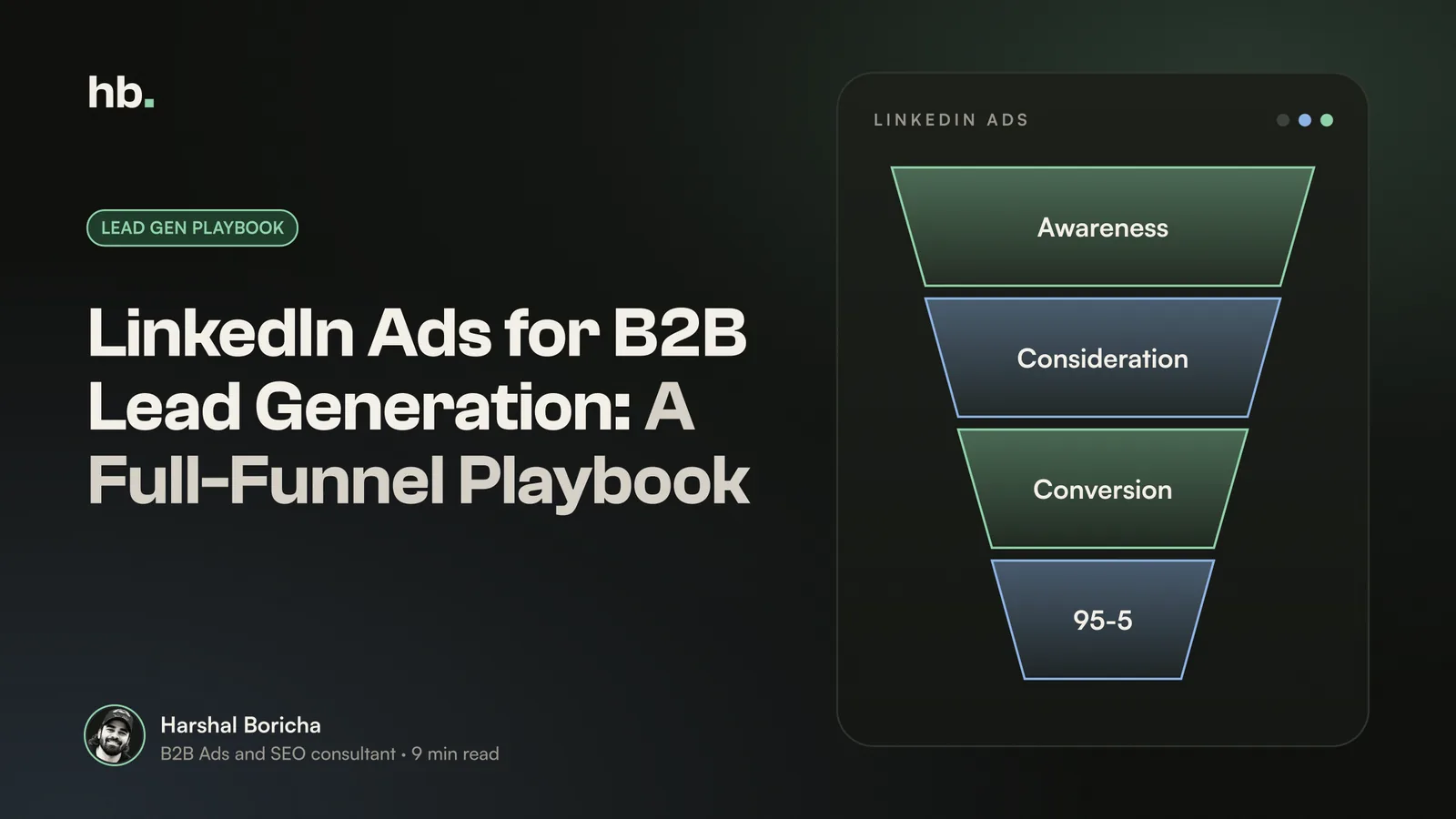
Here is the three-layer structure I start most B2B accounts with. The exact budget split changes by business, but the logic stays the same.
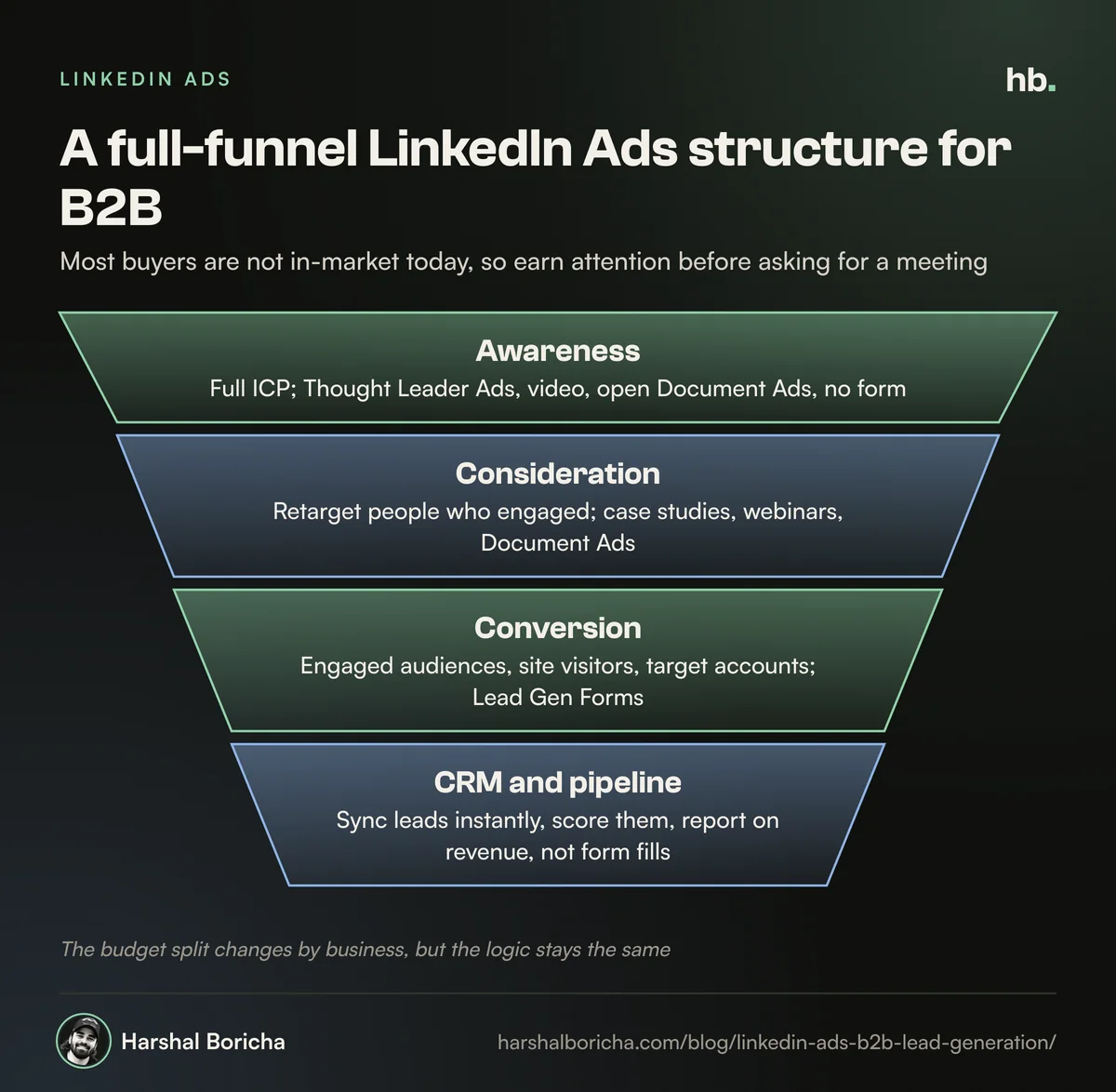
| Layer | Who you target | Goal | Typical formats |
|---|---|---|---|
| Awareness | Your full ideal customer profile (ICP) | Get remembered, build engaged audiences | Thought Leader Ads, video, single image, open Document Ads |
| Consideration | People who engaged with layer one | Deepen trust, show proof | Case study content, webinars, Document Ads |
| Conversion | Engaged audiences, website visitors, target accounts | Capture qualified leads | Lead Gen Form offers, demo or assessment pages |
Layer one: awareness to your ideal customer profile
Build the audience from firmographics and job attributes: industry, company size, function and seniority. If you sell to a defined list of accounts, upload a company list. LinkedIn's Matched Audiences guidance suggests company lists of at least 1,000 companies, combined with job title or seniority. I cover the targeting options in more depth in my guide to LinkedIn Ads targeting for B2B.
The content here should teach something useful with no form attached. A sharp point of view from your founder, a short video explaining a problem your buyers face, or an open document they can read in the feed.
Layer two: consideration through engagement retargeting
LinkedIn lets you build audiences from people who interacted with your video ads, document ads, lead gen forms, company page, events or website. This is where the funnel starts paying for itself. You are now showing ads to people who already gave you a few seconds of attention.
Show them proof. Customer stories, a breakdown of how you solve a specific problem, or an invitation to a webinar.
Layer three: conversion to engaged and in-market audiences
Only now do you ask for contact details. Your conversion campaigns should target engaged audiences, website visitors captured by the LinkedIn Insight Tag, and your priority account list. You can also exclude existing customers using a contact list, so you are not paying to show prospecting ads to people who already pay you.
Creative formats worth testing for B2B
A few formats consistently earn their place in B2B LinkedIn ads.
Thought Leader Ads
Thought Leader Ads let you sponsor posts from individuals rather than from your company page. The author approves the request inside Campaign Manager. Buyers trust people more than logos, so a well-written post from your founder or head of product often outperforms polished brand creative. They are available for awareness, engagement and video view objectives, which makes them ideal for layer one.
Document Ads
Document Ads let members read a document directly in their feed. You can share it openly for awareness, or gate it behind a Lead Gen Form. I like running the same asset both ways: open at the top of the funnel, gated in retargeting, where people already know the content is worth their time.
Single image and video
Still the workhorses. Use them for clear, single-message ads: one problem, one insight, one next step. Video also gives you a clean engagement audience to retarget.
LinkedIn Lead Gen Forms vs landing pages
LinkedIn Lead Gen Forms open inside LinkedIn and come prefilled with the member's profile data, such as name, company, job title and seniority. That removes almost all friction. LinkedIn says most of its pilot customers beat their cost per lead goals with these forms, and in my experience they almost always produce more leads than sending people to a website.
Low friction cuts both ways, though. When submitting takes two taps, some people submit without much intent. Here is how I decide.
| Use Lead Gen Forms when | Use a landing page when |
|---|---|
| The offer is light: a guide, benchmark, template or event | The ask is heavy: a demo, audit or pricing conversation |
| You want volume to feed a nurture programme | The buyer needs context before converting |
| Your audience is mostly on mobile | You want to qualify with on-page content and a calendar booking |
To protect lead quality on forms, a few things help:
- Keep it short, but add one qualifier. LinkedIn's own guidance recommends around three or four fields. I usually add one question, such as company size or timeline, that sales actually uses.
- Make the thank-you message specific. Tell people exactly what happens next and when.
- Use hidden fields. Tag every lead with the campaign and offer so you can judge quality by source later.
- Judge on pipeline, not cost per lead. A cheaper lead that never becomes an opportunity is not cheaper.
Offers that work for B2B (beyond "Book a demo")
"Book a demo" is the right offer for perhaps the 5% who are ready. For everyone else, you need something worth exchanging an email address for. Some offers I have seen work well in B2B:
- Benchmarks and industry reports. "What 50 mid-size manufacturers spend on logistics" is far more tempting than "Download our brochure".
- Templates and calculators. An ROI calculator, an RFP template or a vendor evaluation checklist.
- Short assessments. A free, specific review, such as an audit of one process, positioned as useful whether or not they buy.
- Webinars and roundtables. Especially with a customer or a known industry voice on the panel.
- Gated playbooks. A practical guide that solves one real problem, delivered as a Document Ad.
Say you sell compliance software to Indian NBFCs. A one-page checklist of upcoming regulatory deadlines will attract far more of the right people than a generic "See our platform" ad, and it gives your sales team a natural reason to follow up.
Sync LinkedIn leads to your CRM (and close the loop)
This is where many campaigns quietly break. Leads sit in Campaign Manager, someone downloads a CSV once a week, and by the time sales calls, the buyer has forgotten who you are.
Connect your lead gen forms to your CRM or marketing automation platform so leads arrive instantly. HubSpot, for example, describes its LinkedIn Ads integration as syncing leads automatically, using CRM data to build audiences, and showing which ads influence revenue. Salesforce and other CRMs have similar connectors.
Once leads are in the CRM, score and grade them. Salesforce's lead generation guide separates lead scoring (how engaged someone is) from lead grading (how well they fit your ideal customer). Both matter for LinkedIn leads, because a senior title at the wrong kind of company is still a poor lead.
Then send the outcome back. Track which campaigns create opportunities and closed deals, not just leads. I go deeper on this in tracking B2B leads to revenue.
Budget reality for Indian B2B teams
LinkedIn is not a cheap channel, and Indian B2B teams used to rupee-priced media often feel that sharply. That is fine if your deal sizes justify it. If you are working out what to expect, my breakdown of LinkedIn Ads cost in India covers it in detail.
The bigger mistake I see in LinkedIn Ads for B2B lead generation is spreading a small budget across too many campaigns. With a modest budget, it is better to run one awareness campaign and one retargeting conversion campaign well than six campaigns that never gather enough data. And if your buyers already search for what you sell, read my comparison of Google Ads vs LinkedIn Ads before you decide where the first rupee goes.
How I set this up for clients
When I take on a LinkedIn account, I start with the sales team, not the ad account. Who are the buyers, which deals closed last year, and what does a good lead actually look like to them? That answer shapes the targeting, the offers and the qualifying question on every form.
From there I build the three layers, connect the forms to the CRM, and report on opportunities and pipeline rather than cost per lead. For warm audiences who have already visited your site, I often add Meta retargeting as a lower-cost reminder layer. You can see how I run this on my LinkedIn Ads for B2B service page, browse all services, or read my guide to Google Ads vs LinkedIn Ads if you are still choosing a channel. If any term here is new, my B2B marketing glossary explains it plainly.
If you would like a second opinion on your current campaigns, book a call and we can walk through your account together.
The short version
- LinkedIn Ads for B2B lead generation work best as a full funnel: awareness, engagement retargeting, then conversion.
- Most of your market is not buying today, so spend some budget earning attention before asking for a meeting.
- Thought Leader Ads and Document Ads are two of the strongest B2B formats on the platform.
- Use Lead Gen Forms for light offers and landing pages for heavy asks, and judge both on pipeline.
- Sync leads to your CRM instantly, score them, and report on revenue, not form fills.
Frequently asked questions
Are LinkedIn Ads worth it for B2B lead generation?
Yes, when your buyers are defined by job title, seniority, company or industry, because LinkedIn lets you target exactly those people. It is a more expensive channel per click than most, so it pays off when deal sizes are meaningful and when you run it as a full funnel with retargeting, rather than a single cold campaign asking for a demo.
Should I use LinkedIn Lead Gen Forms or a landing page?
Use Lead Gen Forms for lighter offers like guides, benchmarks and event sign-ups, because the prefilled form removes friction. Use a landing page when you need the buyer to read more before converting, such as a demo or assessment request. Many accounts use both, and the deciding metric should be qualified pipeline per rupee, not cost per lead.
How many fields should a LinkedIn Lead Gen Form have?
LinkedIn's own guidance suggests keeping forms short, around three or four fields, because fewer fields usually convert better. I usually add one qualifying question, such as company size or timeline, when lead quality matters more than volume. Avoid open text questions where possible, since they add effort for the buyer.
How long before LinkedIn Ads generate B2B leads?
Conversion campaigns can produce form fills within days, but a full-funnel programme takes longer to show its real value. Awareness and engagement layers need a few months to build retargeting audiences large enough to convert, and B2B sales cycles add more time before leads become pipeline. I judge a LinkedIn programme on a quarter of data, not a week.
What are Thought Leader Ads on LinkedIn?
Thought Leader Ads let a company sponsor posts written by individuals, such as founders, executives or employees, instead of posts from the company page. The author approves the request in Campaign Manager. They work well in B2B because buyers tend to engage more with a named person than with a logo.
Sources
- How B2B Brands Grow (LinkedIn B2B Institute)
- Lead Gen Forms (LinkedIn Marketing Solutions)
- How to Use LinkedIn Lead Gen Forms (LinkedIn Marketing Blog)
- Thought Leader Ads best practices (LinkedIn Marketing Solutions)
- Document Ad Best Practices (LinkedIn Marketing Solutions)
- Best Practices for Matched Audiences (LinkedIn Ad Tips)
- HubSpot & LinkedIn Ads: Better Together (HubSpot)
- What is Lead Generation? Guide and Best Practices (Salesforce)

B2B Ads and SEO consultant in Mumbai. Nine years in performance marketing, working only with B2B teams. More about me.
Want help with LinkedIn Ads?
LinkedIn Ads consultant for B2B teams. Account-based targeting, lead gen forms and Meta retargeting that turn the right companies into qualified pipeline.