If you have a B2B paid media budget and one decision to make, the question usually lands on Google Ads vs LinkedIn Ads. One platform is built on what people search for, the other on who people are at work, and both will happily take your money. This guide gives you a fair side-by-side comparison, a clear rule for when to use which, how the two work together, and a budget split you can use as a starting point.
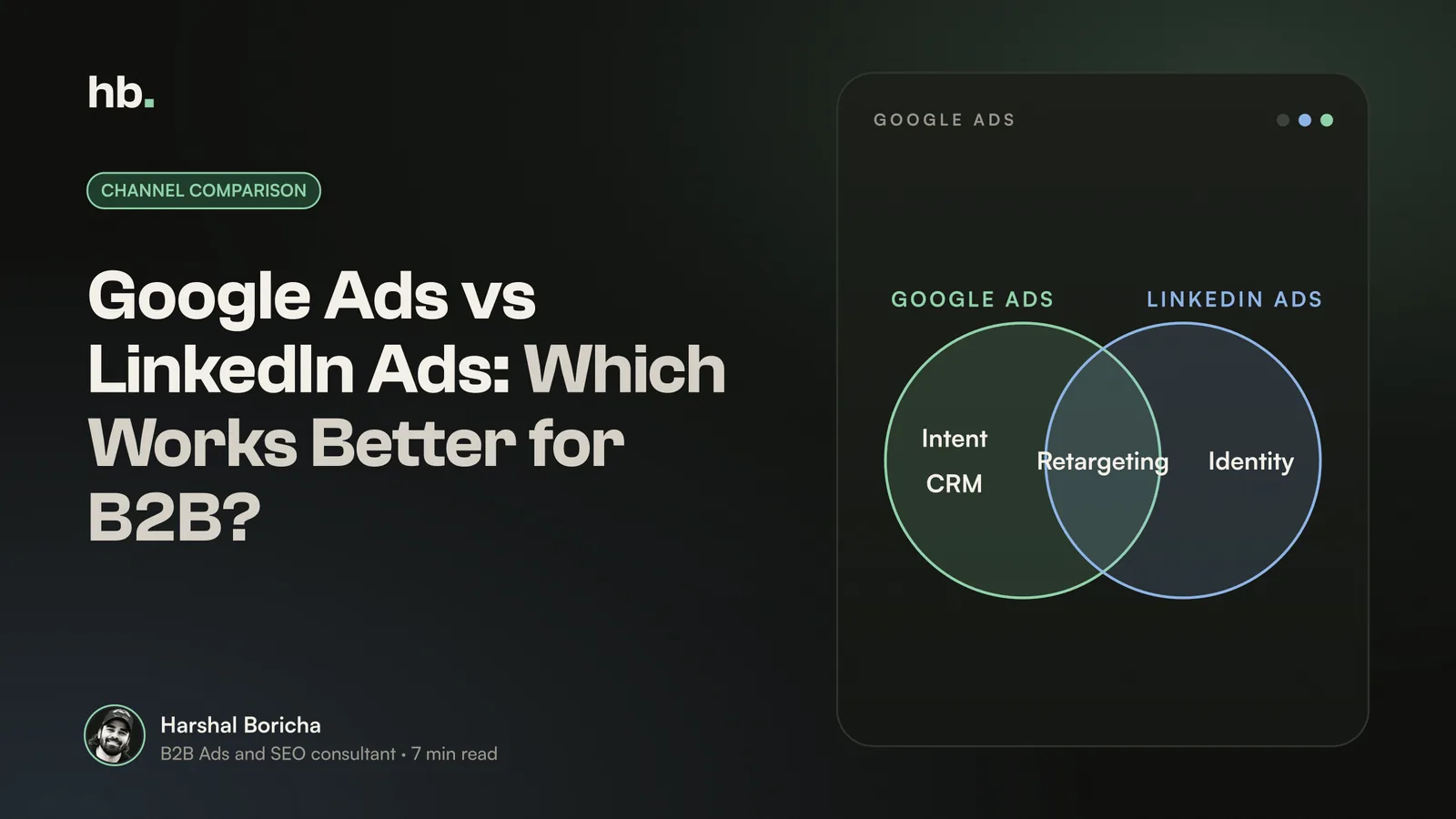
The core difference: intent vs identity
Google Ads, at least on Search, is about intent. Someone types "payroll software for 200 employees" and you can show an ad at that exact moment. You do not know their job title, but you know what they want right now.
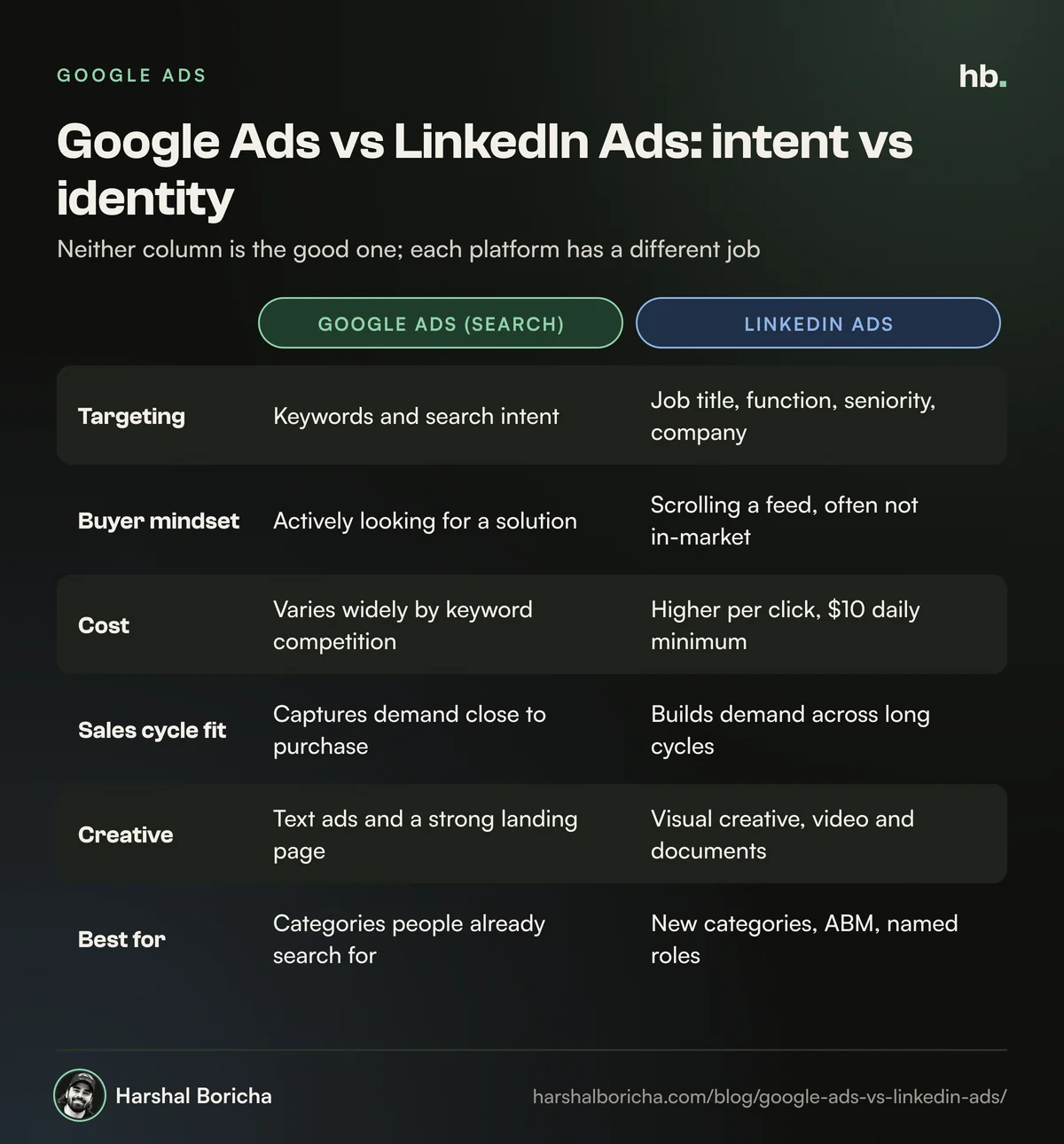
LinkedIn Ads is about identity. You can reach every Head of Procurement at Indian manufacturing companies with more than 500 employees. You know exactly who they are, but most of them are not looking for you today.
In the Google Ads vs LinkedIn Ads decision, that single difference explains almost everything else: cost, lead quality, creative needs and which stage of the funnel each platform suits.
Google Ads vs LinkedIn Ads: side-by-side comparison
| Factor | Google Ads (Search) | LinkedIn Ads |
|---|---|---|
| How targeting works | Keywords and search intent | Job title, function, seniority, company, industry, account lists |
| Buyer mindset | Actively looking for a solution | Scrolling a professional feed, often not in-market |
| Who you reach | Anyone searching, including students, job seekers and competitors | The professional profile you define |
| Cost | Varies widely by keyword competition | Generally higher per click, with a $10 daily minimum per campaign |
| Lead quality | High intent, but needs negative keywords to filter noise | Strong fit by role, but intent varies, so qualification matters |
| Sales cycle fit | Best for capturing demand close to purchase | Best for building demand across long, committee-led cycles |
| Creative needs | Mostly text ads plus a strong landing page | Visual creative, video, documents and thought leadership content |
| Best for | Categories people already search for | New categories, ABM, reaching named roles and accounts |
A few notes on that table, because neither column is the "good" one.
Google's weakness is the audience you cannot control. A search for "CRM software" comes from a founder, an intern writing an assignment and a competitor checking your ads. Google's own documentation on keyword match types explains that broad match can show your ad on searches that do not share your keyword's exact meaning. In B2B that makes negative keywords for B2B Google Ads essential, not optional.
LinkedIn's weakness is timing. The LinkedIn B2B Institute's research on how B2B brands grow points out that most buyers are "out-market" at any given time. On LinkedIn, you reach the right people mostly at the wrong moment. That is not a flaw if you plan for it, but it does mean cold LinkedIn campaigns asking for a demo usually disappoint.
When to use Google Ads for B2B
Google Ads should be your first channel when:
- People already search for your category. If there is real search volume for what you sell, that demand exists with or without you. Someone will capture it.
- Your offer suits a direct response. Quotes, demos, trials, consultations or pricing pages.
- You need measurable results quickly. Search is the easiest channel to tie to leads and, with offline conversion imports, to revenue.
- Your budget is small. You can start narrow, with a tight set of high-intent keywords, and expand as you learn.
Performance Max can extend reach across YouTube, Display, Discover, Gmail and Maps, and Google positions it as a complement to keyword-based Search campaigns. In B2B, I only add it once conversion tracking reflects real qualified leads, otherwise it optimises toward whatever form fills are easiest to get. My guide to Google Ads for B2B covers this in detail.
When to use LinkedIn Ads for B2B
LinkedIn should lead when:
- Your buyers are defined by role, not by search behaviour. A CFO at a logistics company may never search for your solution, but you can find them on LinkedIn.
- You run account-based marketing. LinkedIn's Matched Audiences guidance supports uploading company lists, recommending at least 1,000 companies, and layering job title or seniority on top.
- Your category is new. If nobody searches for what you sell yet, Google has little demand to capture. LinkedIn helps you create it.
- Deal sizes justify the cost. If one closed deal is worth several lakh rupees or more, a higher cost per lead is easy to absorb.
I go deeper on structure and offers in LinkedIn Ads for B2B lead generation, and on what to expect from rupee budgets in LinkedIn Ads cost in India.
How Google Ads and LinkedIn Ads work together
The best B2B programmes I see do not treat Google Ads vs LinkedIn Ads as an either/or choice. They give each platform a job.
- LinkedIn creates familiarity. Your ideal buyers see useful content from your brand and your leaders over weeks and months.
- Google captures the moment. When those buyers finally search, your name is one they recognise, and your branded and category ads are there.
- Retargeting connects the two. People who visit your site from either channel can be shown follow-up ads on LinkedIn, and on Meta as a lower-cost reminder.
- Your CRM keeps score. Leads from both platforms are tracked to opportunities and revenue, so budget moves toward what actually closes.
One signal I watch closely: when LinkedIn awareness is working, branded search volume and direct traffic on Google tend to rise. If you only judge LinkedIn on last-click leads, you will underrate it and cut it too early.
Where Meta fits for B2B retargeting
Meta is rarely the right channel for cold B2B prospecting, because you cannot target by job title or company the way LinkedIn allows. As a retargeting layer, though, it is genuinely useful.
Meta's website custom audiences let you build audiences from people who visited your site, using the Meta Pixel or Conversions API events. Your B2B buyers still scroll Instagram and Facebook in the evening. Showing a case study or webinar invite to recent site visitors there keeps you in front of them at a much lower cost than LinkedIn frequency.
I treat Meta as the third layer: small budget, warm audiences only, focused on content and reminders rather than hard asks.
A sample budget split framework (a starting point)
There is no correct split for every business. What follows is the framework I use to start a conversation, and it always changes once real data comes in. Treat these as starting points, not rules.
| Your situation | Google Ads | LinkedIn Ads | Meta retargeting |
|---|---|---|---|
| Strong existing search demand | 60 to 70% | 25 to 35% | 5 to 10% |
| Balanced: some search demand, clear target roles | 40 to 50% | 40 to 50% | 5 to 10% |
| New category or ABM to a named account list | 20 to 30% | 60 to 70% | 5 to 10% |
Say you are a Mumbai-based SaaS company selling HR software to mid-size Indian firms, with a hypothetical INR 3,00,000 monthly paid budget. There is clear search demand for HR and payroll software, so you might start near the first row: roughly INR 1,95,000 on Google Search, INR 90,000 on LinkedIn awareness and retargeting to HR heads, and INR 15,000 on Meta retargeting site visitors.
After 60 to 90 days, look at qualified opportunities and pipeline by channel, not cost per lead, and shift budget accordingly. Two rules I hold to:
- Do not spread a small budget too thin. LinkedIn sets a $10 daily minimum per campaign, but each campaign needs enough spend to learn. Three well-funded campaigns beat ten starved ones.
- Measure to revenue. Google's offline conversion imports let you send closed deals back into Google Ads, and Salesforce's lead generation guide explains why scoring and grading leads matters before passing them to sales. My guide to tracking B2B leads to revenue shows how to connect the pieces.
How I decide this for clients
I rarely start with a platform. I start with three questions: do your buyers search for what you sell, can we name the roles and companies we want, and how long does a deal take to close? The answers usually make the split obvious.
From there I run Google Search to capture existing demand through my B2B Google Ads management, and LinkedIn with Meta retargeting through my LinkedIn Ads for B2B service. Paid media also works best alongside organic, so many clients pair it with B2B SEO. You can see all of it on the services page, and if you want to talk through your own split, book a call.
The short version
- Google Ads vs LinkedIn Ads is really intent vs identity: Google reaches people searching now, LinkedIn reaches the right people before they search.
- Lead with Google when search demand exists, and with LinkedIn when your buyers are defined by role or account list.
- Run them together: LinkedIn builds familiarity, Google captures the moment, Meta adds low-cost retargeting.
- Use the budget split table as a starting point, then move money toward the channel that creates qualified pipeline.
- Track every lead to revenue in your CRM, or you will make budget decisions on the wrong numbers.
Frequently asked questions
Is Google Ads or LinkedIn Ads better for B2B?
Neither is better in general. Google Ads is usually better when buyers already search for what you sell, because you reach them at the moment of need. LinkedIn Ads is better when you need to reach a specific job title or company list that is not searching yet. Most B2B companies with a meaningful budget get the best results by running both, each doing a different job.
Why are LinkedIn Ads more expensive than Google Ads?
LinkedIn charges for very precise professional targeting, such as job title, seniority and company, on a smaller audience than Google reaches. That precision is what you pay for. Whether it is expensive depends on your deal size and on how many of those clicks turn into qualified pipeline, not on the cost per click alone.
What is the minimum budget for LinkedIn Ads?
LinkedIn states a minimum daily budget of $10 per campaign, for any ad format. That minimum is a technical floor, not a recommendation. A useful B2B programme with awareness and retargeting campaigns typically needs more, so plan your budget around the number of layers you want to run.
Should a B2B startup start with Google Ads or LinkedIn Ads?
If people already search for your product category, start with Google Search, because it captures existing demand and is easier to measure. If your category is new and nobody searches for it yet, start with LinkedIn to reach the right roles and build awareness, then add Google once branded and category searches begin to appear.
Can Meta Ads work for B2B?
Yes, mainly as a retargeting layer. Meta lets you build website custom audiences from people who visited your site, so you can remind them about your content or offer at a lower cost than LinkedIn. It is weaker for cold B2B prospecting because you cannot target by job title or company the way LinkedIn allows.
Sources
- About keyword matching options (Google Ads Help)
- About Performance Max campaigns (Google Ads Help)
- About offline conversion imports (Google Ads Help)
- Making the Most of Your Budget (LinkedIn Ad Tips)
- Best Practices for Matched Audiences (LinkedIn Ad Tips)
- How B2B Brands Grow (LinkedIn B2B Institute)
- Website Custom Audiences (Meta for Developers)
- What is Lead Generation? Guide and Best Practices (Salesforce)

B2B Ads and SEO consultant in Mumbai. Nine years in performance marketing, working only with B2B teams. More about me.
Want help with Google Ads?
B2B Google Ads management by Harshal Boricha. Search and Performance Max built around buying intent, qualified leads and pipeline, not cheap clicks.